
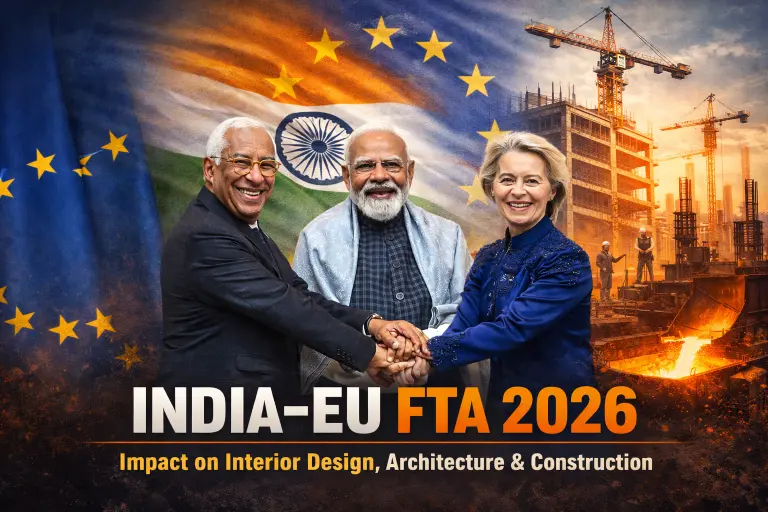
India–EU FTA Interior Design dynamics are set to change dramatically after the historic trade agreement signed on January 27, 2026. The deal is expected to reshape architecture practices, construction material sourcing, and access to European-quality interiors across India.
For the first time, European-quality design, machinery, and fittings are becoming accessible at scale—while Indian builders face new sustainability-linked cost pressures. The agreement effectively redraws the cost-quality equation for Indian real estate and design projects.
Below is a sector-specific breakdown of what changes in 2026 and beyond.
European Luxury Enters the Indian Mainstream
Luxury Furniture & Decor: A Structural Price Reset
High import duties have long kept authentic European furniture restricted to ultra-luxury projects. That barrier is now weakening.
-
Duty Reduction: Import tariffs on premium furniture, lighting, and home décor items will be reduced gradually under the FTA framework.
-
Expected Impact: International brands such as Poltrona Frau and BoConcept are likely to see 10–15% price corrections once new shipments arrive.
-
Industry Effect: Interior designers can now specify original European products for hotels, Grade-A offices, and high-end residences—reducing dependence on replicas and custom knock-offs.
This shift is expected to raise aesthetic and durability benchmarks across the premium interior segment.
Hardware & Fittings: The German Standard Goes Mass
One of the most immediate wins comes in architectural hardware.
-
Capital Goods Relief: The FTA sharply reduces duties on industrial fittings and building hardware.
-
Market Change: Products from German brands like Hettich and Häfele will become more competitively priced and easier to source.
-
Ripple Effect: Soft-close mechanisms, precision sliders, and high-cycle hinges are likely to become standard expectations rather than luxury add-ons—forcing Indian hardware manufacturers to upgrade quality.
Manufacturing Boost: A Quiet Revolution in Indian Joinery
Perhaps the most transformative impact lies behind the scenes—in factories rather than showrooms.
-
Machinery Imports Get Cheaper: Duties on European woodworking and stone-processing machinery (CNC routers, edge banders, automated panel saws) are being reduced to near zero.
-
Cost Advantage: Indian furniture and modular kitchen manufacturers can now upgrade factories at 20–30% lower capital expenditure.
-
Outcome: Higher precision, better finishes, and faster production cycles for “Made in India” kitchens, wardrobes, and custom furniture.
This positions Indian manufacturers to compete not just domestically, but also as export-oriented suppliers.
Construction Materials: The Green Cost Challenge
While interiors benefit from cost efficiencies, core construction materials face a more complex future.
Green Steel and Cement Pressure
The EU’s Carbon Border Adjustment Mechanism (CBAM) introduces sustainability-linked costs.
-
Compliance Cost: Indian producers exporting to Europe must shift toward low-carbon manufacturing.
-
Domestic Impact: Companies like Tata Steel and JSW Steel may pass part of these transition costs to the domestic market.
-
Builder Concern: Steel and cement prices in India could remain volatile through 2026, affecting project budgeting and timelines.
Tiles & Surfaces: Export Opportunity, Local Tightness
-
Morbi Advantage: Reduced trade barriers make Indian ceramic tiles more competitive in European markets.
-
Domestic Risk: As exporters prioritize higher-margin EU orders, Indian architects may face short-term supply tightness or price increases in premium slabs and large-format tiles.
Architectural Services: Indian Firms Go Global
The FTA’s services chapter could redefine how Indian design firms operate internationally.
-
Qualification Recognition: The agreement aims to simplify mutual recognition of professional credentials.
-
New Business Models: Indian firms can more easily export services like BIM modeling, working drawings, sustainability consulting, and 3D visualization to EU-based projects.
-
Long-Term Effect: India strengthens its position as a global backend for architectural and design execution—not just IT services.
Conclusion: A Quality-Driven Reset for the Industry
The India–EU FTA is not just a trade agreement—it is a quality reset for Indian construction and design. European finishes become more affordable, manufacturing standards rise, and clients grow more demanding. At the same time, sustainability-linked costs push builders toward greener, more efficient practices.
In 2026 and beyond, firms that realign supply chains, upgrade factories, and embrace European benchmarks will lead India’s next real estate cycle.
Frequently Asked Questions (FAQ)
Q1: Will luxury European furniture become cheaper immediately?
A: Partial price corrections (10–15%) are expected over the next few months, while deeper cuts will roll out gradually as phased tariff reductions take effect.
Q2: How does the FTA help Indian interior designers?
A: Designers gain easier access to authentic European products, better hardware pricing, and higher-quality Indian-manufactured furniture enabled by cheaper machinery imports.
Q3: Why could steel and cement prices stay high despite freer trade?
A: Sustainability requirements under the EU’s carbon rules increase production costs, which may be passed on domestically during the transition period.
Q4: Is this a good time to invest in a furniture or modular kitchen factory?
A: Yes. Lower machinery import duties significantly reduce setup and upgrade costs, improving long-term margins.
Q5: What does this mean for Indian architects working abroad?
A: The services framework improves cross-border recognition, making it easier for Indian firms to serve European clients remotely or collaboratively.
 , All Rights Reserved