
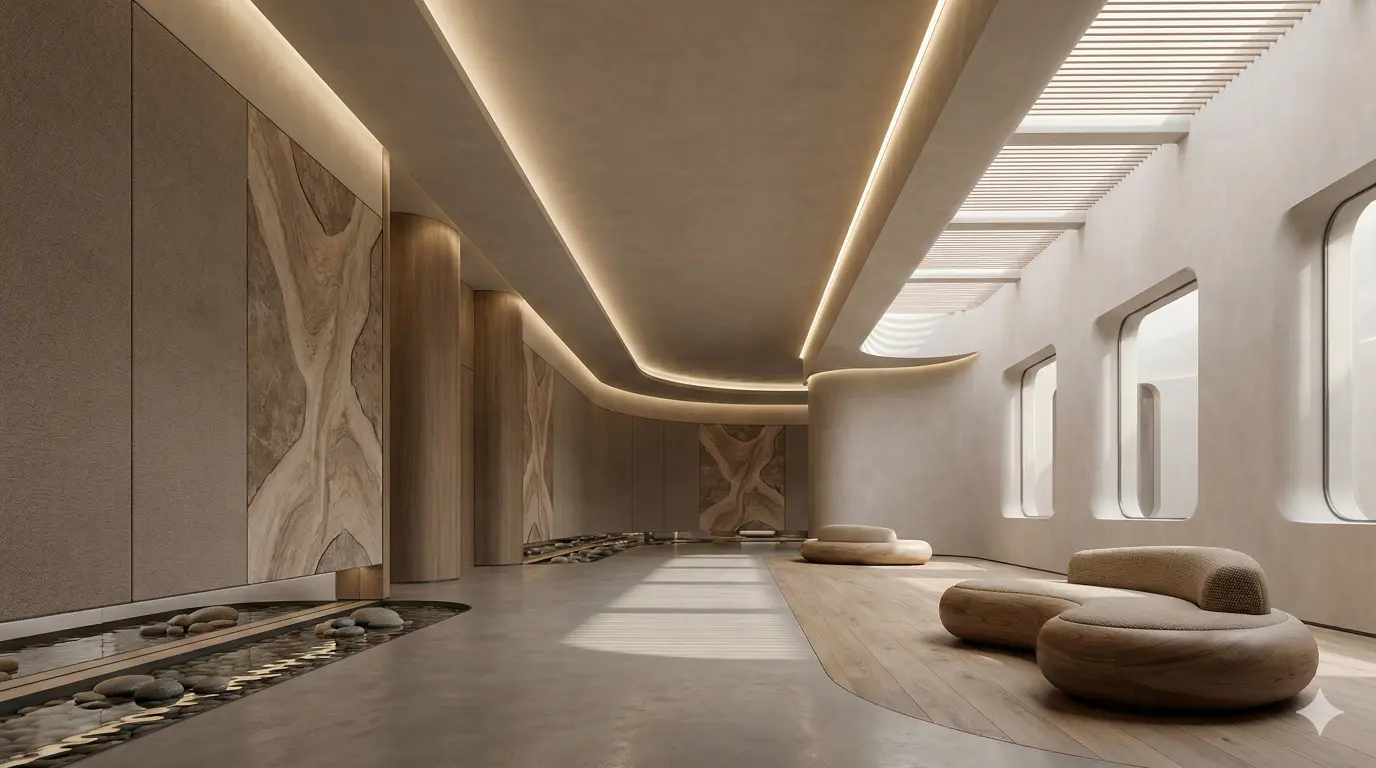
Commercial interior design trends 2026 are redefining how offices, hospitals, and public spaces are planned, shifting the focus from open layouts to stress-reducing environments. Designers are now prioritising mental well-being, acoustic comfort, and biological responses over visual impact alone. This marks a fundamental change in how commercial interiors are measured and valued.
The age of loud, hyper-social offices filled with open desks and recreational gimmicks is fading fast. As 2026 approaches, commercial interior design is being redefined by one core question: does this space actively reduce stress for the people using it? Across workplaces, hospitals, airports, and retail hubs, design success is now measured by its impact on human biology—especially stress regulation—rather than visual drama alone.
Mental Well-being Becomes the Core Design Metric
For decades, productivity drove commercial interiors. Today, mental well-being has moved to the centre of design strategy. Architects and interior designers are increasingly guided by research showing how lighting, sound, textures, and spatial planning influence stress hormones and cognitive fatigue.
This approach—often described as neuro-architecture—prioritises calmer acoustics, adaptive circadian lighting, and layouts that balance collaboration with privacy. Instead of overstimulating environments, designers are creating spaces that support focus, emotional regulation, and long-term health.
Biophilia 2.0: Designing Like Nature, Not Just Adding Plants
The familiar formula of green walls and indoor plants is evolving into what experts call Biophilia 2.0. Rather than decorative greenery alone, the new focus is on biomimicry—replicating nature’s patterns, proportions, and rhythms within architecture.
Designers are integrating fractal geometries, layered textures, and organic forms into floors, walls, ceilings, and furniture. These repeating natural patterns are known to calm the human visual system, creating a state of relaxed alertness without relying solely on live vegetation. The result is a more durable and scientifically grounded form of biophilic design.
World Interior of the Year: A Signal for the Industry
One of the strongest validations of this shift came when the World Interior of the Year title was awarded to the Fractal Chapel at the State Hospital in Graz, Austria, designed by INNOCAD Architecture.
The chapel stands out not as a decorative landmark but as a therapeutic interior. Laser-cut fractal patterns across its surfaces echo the visual complexity of natural environments such as forests and clouds. Developed with insights from neuroscience, the space demonstrates how architecture can actively support emotional recovery and mental calm. Its global recognition signals that evidence-based, human-centred design is no longer niche—it is becoming the benchmark.
Sanctuary Spaces: Silence as a Design Feature
As digital overload increases, silence has emerged as a premium asset in commercial environments. Sanctuary spaces are now replacing traditional breakout rooms. These zones are intentionally designed for focus, decompression, and mental reset.
Common features include acoustic isolation, subdued lighting, minimal visual stimulation, and technology-free policies. From corporate headquarters to transport hubs, these spaces offer relief from constant noise and notifications, reinforcing the idea that calm is essential infrastructure, not a luxury add-on.
Future Outlook: Designing for the Human Nervous System
Looking beyond 2026, wellness-led interiors are expected to influence regulations and certification standards. Frameworks such as WELL and LEED are already expanding their emphasis on lighting quality, acoustic comfort, and psychological well-being.
Commercial spaces that succeed in the future will be those designed around the biological limits of their users. Stress reduction, focus support, and emotional balance are becoming non-negotiable expectations rather than optional enhancements.
Frequently Asked Questions (FAQ)
Q1: What is neuro-architecture in commercial design?
Neuro-architecture applies neuroscience research to design, focusing on how spaces affect stress, focus, mood, and overall mental well-being.
Q2: How is Biophilia 2.0 different from traditional biophilic design?
Traditional biophilia uses direct natural elements like plants. Biophilia 2.0 focuses on biomimicry—using nature-inspired patterns, forms, and light to create calming environments.
Q3: What are sanctuary spaces in offices and public buildings?
Sanctuary spaces are quiet, low-stimulation areas designed for deep focus or mental recovery, often featuring acoustic control and minimal technology.
Q4: Why is stress reduction becoming a priority in interior design?
Research shows that chronic environmental stress lowers productivity and well-being. Design that reduces stress supports healthier, more sustainable performance.
Q5: What does the Fractal Chapel’s award mean for the industry?
Its recognition shows that globally, the design industry now values spaces that deliver measurable psychological and emotional benefits, not just visual appeal.
The future of commercial interiors is no longer about spectacle or density. It is about designing environments that respect the human nervous system. As neuro-architecture, biomimicry, and sanctuary spaces gain momentum, the most successful buildings will be those that make people feel better the moment they step inside.
 , All Rights Reserved