
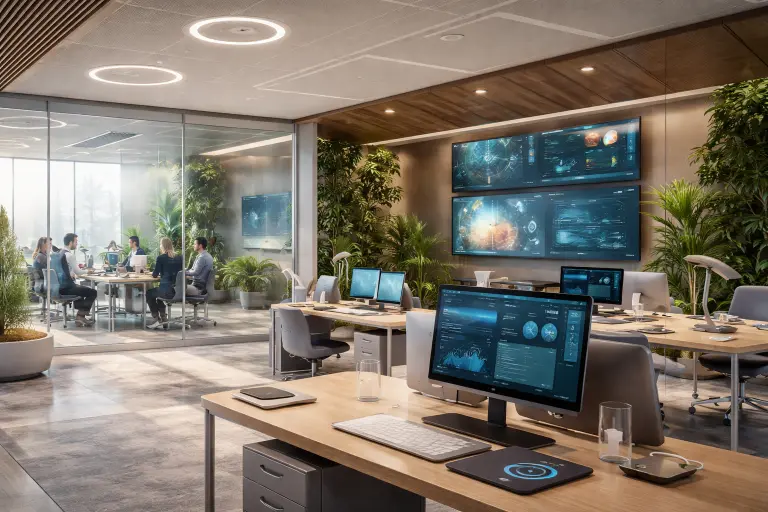
AI and IoT in commercial interiors are no longer futuristic concepts—they have become essential elements of modern office planning. In 2026, businesses are investing heavily in smart commercial spaces that offer automation, energy savings, employee wellness, and seamless technology integration without compromising premium interior aesthetics.
The smart office market is projected to reach approximately $66.52 billion in 2026, with more than 55% of growth driven by retrofitting existing office spaces. This proves that organizations are upgrading current interiors rather than rebuilding from scratch, making AI-powered solutions a top priority for architects, interior designers, and workspace planners.
In this article, we explore how AI and IoT are transforming commercial interiors and how businesses can implement these technologies seamlessly.
The Rise of Smart Commercial Interiors in 2026
Smart commercial interiors are no longer a luxury trend. They are becoming a necessity because businesses want:
-
Higher productivity
-
Lower operational costs
-
Better energy efficiency
-
Improved employee wellness
-
Flexible hybrid workspaces
-
Premium design aesthetics with hidden technology
The demand is clear: offices must be both beautiful and intelligent.
1. Sensor-Driven Lighting & Circadian Rhythm Design
Lighting has become the central nervous system of modern office interiors. In 2026, lighting is no longer limited to dimming or motion detection. It is now powered by AI-driven sensor networks and designed to support employee wellness.
Circadian Tuning: Lighting That Matches the Sun
Human-centric lighting (HCL) systems now mimic natural sunlight patterns.
-
Morning lighting uses cool tones (5000K–6500K) to boost alertness and cortisol production.
-
Evening lighting shifts to warm amber tones (2700K) to support relaxation and melatonin production.
This is especially useful in offices where employees work long hours under artificial lighting.
Productivity Data
Research suggests that circadian-friendly lighting improves self-reported workplace performance by up to 18%, making it a key design investment for modern offices.
Power-over-Ethernet (PoE): The Invisible Lighting Revolution
One of the biggest upgrades in 2026 is PoE lighting, where fixtures are powered and controlled through a single Ethernet cable.
Benefits of PoE lighting in commercial interiors:
-
Less wiring and less ceiling clutter
-
Sensors hidden inside luminaires
-
Easier retrofitting for older office spaces
-
Better centralized control and energy monitoring
This allows designers to create clean ceilings without the “industrial tech look.”
2. AI-Powered Space Analytics: Smarter Space Planning
In the hybrid work era, one of the biggest financial losses is unused office real estate. Companies are now relying on AI-driven space analytics tools like Spaceti and Robin to optimize workspace layouts.
Occupancy Monitoring
Anonymous IoT sensors track desk usage, meeting room frequency, and movement patterns using:
-
Infrared sensors (IR)
-
Optical sensors
-
Smart badge data (privacy-safe systems)
This creates a real-time activity map of the entire office.
Predictive Allocation
The real power comes from predictive AI.
Example:
If a 12-person conference room is regularly used by only 3 people, AI will recommend redesigning it into:
-
smaller collaboration pods
-
hybrid Zoom rooms
-
compact meeting booths
Space Efficiency Gains
Companies implementing AI space optimization report:
-
15–18% reduction in real estate footprint
-
better employee satisfaction
-
improved workplace utilization
This means businesses can reduce rental expenses without reducing capacity.
3. Invisible Technology in Premium Meeting Rooms
In 2026, the best-designed offices are those where technology feels invisible.
The modern expectation is a “walk-in-and-work” experience where employees don’t deal with cables, adapters, or complicated meeting setups.
AI-Powered Audio and Video
Meeting rooms now feature ceiling-mounted intelligent systems such as:
-
beamforming microphone arrays
-
AI-first cameras
-
background noise suppression systems
These are often hidden inside:
-
acoustic ceiling panels
-
decorative wall panels
-
ghost fabric finishes
The result: a clean luxury aesthetic with world-class video conferencing.
Wireless Ecosystems
Modern meeting spaces now eliminate clutter with:
-
wireless presentation systems
-
under-desk wireless charging pads
-
cable-free conference tables
This creates a premium boardroom feel while improving usability.
Smart Glass and Privacy Automation
One of the most popular trends in commercial interiors is switchable smart glass.
Smart glass integrates with room booking software so that:
-
when a meeting starts, glass automatically frosts
-
when the room is free, glass turns transparent
This adds both luxury appeal and privacy without curtains or blinds.
SEO Deep Dive: Integrating AI & IoT into Small Office Interiors (Under 2,000 Sq. Ft.)
Small office designs face unique limitations: limited ceiling space, limited storage, and the need to avoid visual clutter.
However, even small offices now demand the same smart capabilities as corporate headquarters.
Here are the best strategies:
Smart Office Strategies for Small Spaces
| Strategy | Small Office Application |
|---|---|
| Multi-Purpose Sensors | Use one sensor for occupancy, light levels, and air quality (CO2/VOCs) to avoid ceiling clutter. |
| Furniture Integration | Smart desks with embedded wireless charging and OLED controls reduce visible gadgets. |
| Cloud-First Infrastructure | Replace server racks with edge gateways as small as routers, hidden inside cabinetry. |
| Acoustic Technology | Smart acoustic panels that double as wall décor improve noise control and aesthetics. |
Key Benefits of AI and IoT in Commercial Interiors (2026 Data)
The business case for smart interiors is now extremely strong.
1. Energy Savings
Occupancy-based HVAC and lighting systems can reduce operational energy usage by:
✅ 22% to 30%
This is a major advantage for businesses facing high electricity costs.
2. Predictive Maintenance
AI-based maintenance tools monitor equipment health and detect early failures.
This reduces repair costs by:
✅ 10% to 15% annually
It also prevents costly downtime due to sudden breakdowns.
3. Faster ROI
With falling IoT hardware costs and affordable 5G-enabled modules, the payback period has reduced dramatically.
Earlier ROI: 5 years
Now ROI: ✅ 24 to 36 months
This makes smart office upgrades a financially smart decision even for mid-size companies.
Pro Tip for Designers: Use Matter-Compatible Devices
To avoid the “server room” look, designers should prioritize Matter-compatible smart devices.
Matter is an interoperability protocol that ensures multiple brands work together without separate hubs.
Why Matter is a Game-Changer
-
fewer control hubs
-
cleaner wiring infrastructure
-
seamless cross-device compatibility
-
easier upgrades in the future
For designers and architects, Matter reduces complexity and improves the final aesthetic.
How AI + IoT Are Redefining Commercial Interior Design Trends
The future of commercial interiors is based on three major design principles:
1. Invisible Integration
Technology should be embedded into walls, ceilings, and furniture—not displayed openly.
2. Wellness-Centered Workspaces
Circadian lighting, air quality monitoring, and noise control will become standard.
3. Flexible Hybrid Layouts
Spaces will be designed to adapt quickly based on usage analytics and AI predictions.
Smart Offices Are the New Standard in 2026
In 2026, commercial interiors are not just about luxury furniture, glass partitions, and premium flooring. They are about designing workplaces that are:
-
responsive
-
efficient
-
data-driven
-
employee-friendly
-
visually modern
With the smart office market expected to reach $66.52 billion, businesses that integrate AI and IoT into their interiors will gain a competitive advantage through cost savings, higher productivity, and superior employee experience.
Smart office design is no longer futuristic—it is the new normal.
Frequently Asked Questions (FAQ)
Q1. What is the best smart technology for office interiors?
Sensor-based lighting, AI space analytics, and smart HVAC systems are considered the most impactful technologies.
Q2. Are smart office upgrades expensive?
Costs have reduced significantly in 2026 due to affordable IoT modules, and ROI is now typically 24–36 months.
Q3. Can small offices use smart office technology?
Yes. Small offices can use multi-purpose sensors, cloud-first infrastructure, and smart furniture to reduce clutter.
Q4. What is Matter compatibility in smart devices?
Matter is a universal protocol that allows devices from different brands to work seamlessly together.
 , All Rights Reserved